Xabi Alonso to Liverpool was not just a managerial idea. It was a memory with a tactics board attached.
The old Anfield midfielder, elegant and cerebral, returning as the modern super-coach. The player who seemed to understand the rhythm of a match a beat early, now shaping the next great Liverpool side from the touchline. It was romantic because it felt coherent before anyone had to explain it.
The data does not say Liverpool were right to pass on Alonso. It says something more interesting: Alonso was a high-upside tactical reset, not a plug-and-play continuation of Klopp's Liverpool.
This is not a defense of Arne Slot's disappointing 2025/26 season, and it is not an argument that Alonso was overrated. Alonso's evidence is stronger in several places, especially Leverkusen's full-season peak and Madrid's partial-window output.
The narrower question is fit. Would Liverpool have been hiring continuity, or asking more of the squad to change jobs?
By low-disruption, this piece means something specific: the ability to keep a back-four base, a wide-forward ecosystem, familiar full-back responsibilities, compatible midfield profiles and established pressing habits without major recruitment or role conversion.
In plain language: how many players would be changing jobs?
Formation Is The First Clue
Formation is not tactics in full, but it is a useful first signal for role architecture: back four or back three, where the width lives, and which players are being asked to become specialists.
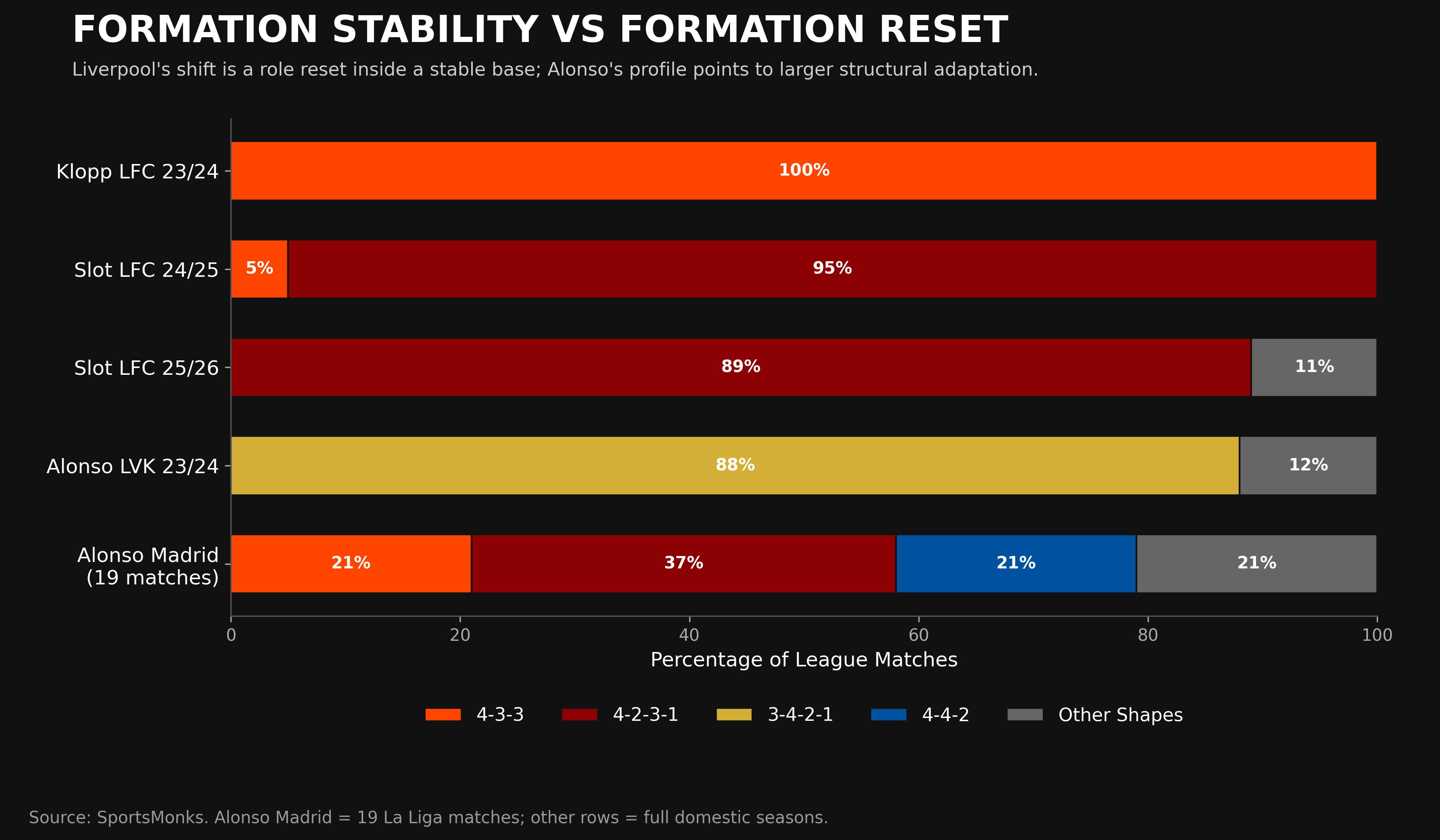
Read the shape evidence as architecture, not gospel. Klopp's final Liverpool league season was listed as a 4-3-3 in all 38 matches. Slot moved the midfield picture, but stayed mostly in a familiar back-four, wide-forward world: 4-2-3-1 in 36 of 38 league matches in 2024/25, then 34 of 38 in 2025/26.
That is continuity, not sameness. Slot changed Liverpool, but he did so inside an ecosystem the squad already understood: full-backs with major responsibility, wide attackers, and a midfield line that did not require the team to become a wing-back side overnight.
Leverkusen's unbeaten side was built on a different role economy. Alonso's best version there used 3-4-2-1 in 30 of 34 league matches, with wing-backs as major weapons, central creators between the lines, and three centre-backs as the base. It was a superb machine: 28 wins, six draws, no defeats, 90 points, 89 goals scored, 24 conceded, plus-65 goal difference.
But brilliance does not remove the translation question. If Liverpool were considering Alonso as a post-Klopp successor, the question would not have been "is this coach good?" It would have been "how many roles have to change for this coach's best football to become our football?"
Role Suitability Is The Hidden Cost
The sharper squad-fit question is not only how many players would be changing jobs. It is whether Liverpool already had enough players who looked suited to those jobs. This is a qualitative role-fit judgment, not tracking data, recruitment reporting or proof that a player could not adapt.
On that reading, Slot's continuation case becomes clearer. A back-four, wide-forward, 4-2-3-1 ecosystem keeps more of Liverpool's post-Klopp squad logic intact. Trent can remain a creative right-back or inverted build-up weapon rather than being tested as a true wing-back specialist. Robertson's role changes less dramatically. Van Dijk stays an elite back-four anchor. Mac Allister still makes sense as a control midfielder, and Szoboszlai can be read as a high-energy No. 10 or advanced midfielder rather than one of two permanent Leverkusen-style inside creators.
Alonso's Leverkusen version asks harder questions. It does not make Liverpool's players bad fits, but it changes the job descriptions. The wing-backs become primary attackers. The centre-back group needs back-three depth and wide-channel comfort. Salah's best Liverpool role as a right-sided wide scorer would need careful protection if the right wing-back owns the touchline. Diaz and Gakpo-type wide forwards could be squeezed toward inside-forward or second-striker work. Nunez might suit the running and chaos of a single-striker role, but less clearly if the centre-forward is required to be a calmer link player.
Madrid complicates this in Alonso's favour. His attributed 19-match window showed that he could use back-four structures and did not have to copy Leverkusen's 3-4-2-1. That reduces the certainty of any recruitment-burden claim. But it does not erase the burden entirely. A Liverpool version of Alonso would still have needed answers at wing-back, central creation and striker profile. The issue was never that Alonso could not adapt. It was that adaptation would have been the job.
Madrid Complicates The Alonso Argument More Than It Settles It
The easy version of the argument would be: Alonso played a back three at Leverkusen, Liverpool are built for a back four, therefore Alonso was not the fit. Madrid breaks that caricature.
In his attributable 2025/26 La Liga window, Madrid did not look like Leverkusen in formation terms. Across 19 league matches before his 12 January 2026 departure, Alonso's Madrid used 4-2-3-1 seven times, 4-3-3 four times, 4-4-2 four times and four other shapes once each. The record was strong: 14 wins, three draws, two defeats, 45 points, 41 goals scored, 17 conceded and plus-24 goal difference between 19 August 2025 and 4 January 2026.
That evidence matters. Alonso was not a back-three prisoner. But 19 league matches before a January departure is evidence of short-window flexibility, not proof of a settled season-long model. And the departure itself was abrupt: Real Madrid moved on after just 233 days, a day after a Spanish Super Cup final defeat to Barcelona, and while the club's statement called the parting mutual, credible reporting framed it as effectively a dismissal. That exit should not be read as proof that Alonso's ideas failed — the tactical causes are not established here — but a club moving on from a coach this quickly is itself part of the "which Alonso would Liverpool get?" question. It does, however, weaken any claim that Madrid supplied a frictionless 38-match proof of concept.
Madrid narrows the objection from "Alonso only plays a back three" to the more serious question: which Alonso would Liverpool actually have been hiring?
The Modern Understat Comparison Cuts Through The Romance
The strongest pro-Alonso argument is not nostalgia. It is performance.
Slot's 2025/26 Liverpool were not merely a stylistic continuation; they fell sharply by results. After Slot's first season held up well at 84 points and plus-45 goal difference, the second ended at 60 points and plus-10. If the debate is only "should Liverpool have chased the better coach?", Alonso has plenty of ammunition.
Understat's modern comparison gives the pro-Alonso case real weight, but the fair comparison is no longer 38 league matches against 38. Alonso's attributable Madrid window is 19 La Liga matches. Slot's Liverpool can therefore be viewed through their first 19 Premier League matches of 2025/26, with Slot's full-season 17W-9D-12L record kept as wider context. If anything, that cut is generous to Slot: by points and xG difference, Liverpool's opening 19 were their stronger phase of 2025/26, with the deeper decline still to come — so Alonso's window is measured against Liverpool nearer their best, and clears it anyway.
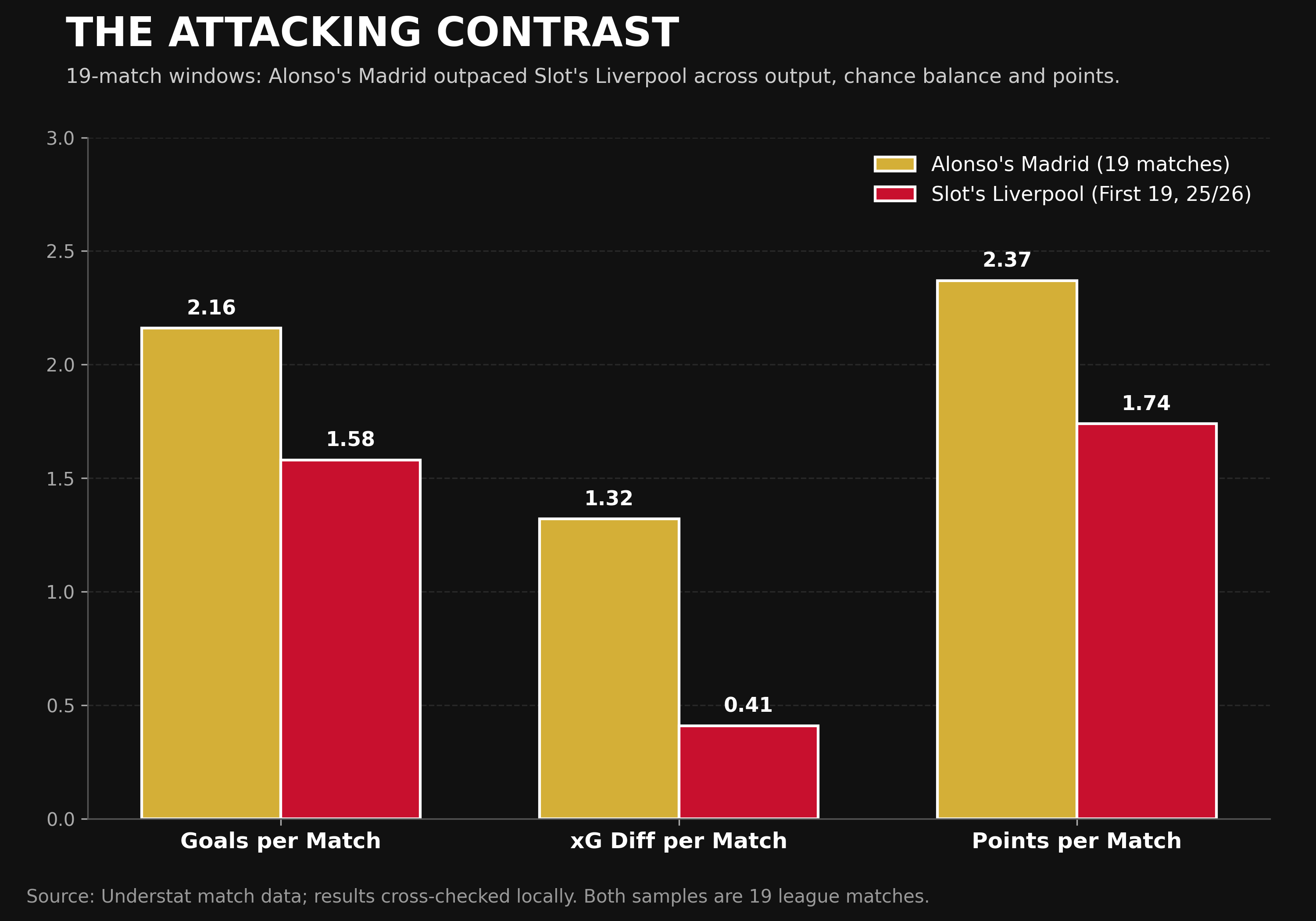
By these broad performance and chance-balance indicators, Alonso's Madrid window looks substantially healthier than Liverpool's first 19 league matches under Slot in 2025/26. Madrid's xG difference per match was +1.317, compared with Liverpool's +0.411 — though these are two different leagues, and a La Liga heavyweight's xG difference is inflated by a top-heavy division, so the two figures are directional rather than strictly like-for-like. Madrid also generated more shots, allowed less xG, scored more, conceded less and carried a much stronger results profile: 14W-3D-2L and 45 points against Liverpool's 10W-3D-6L and 33 points.
The edge was not a mirage. Madrid were better by defensive xG, shot volume and open-play xG, and they had a much larger dead-ball contribution. That profile supports Alonso. It just does not prove he had recreated Liverpool's high-press, open-play model with better numbers.
The pressing signal also resists a lazy continuity reading. PPDA is a blunt measure, but Madrid's higher figure is not clean evidence of Klopp/Slot-style high-press continuity. It is compatible with a very strong team that controlled matches differently.
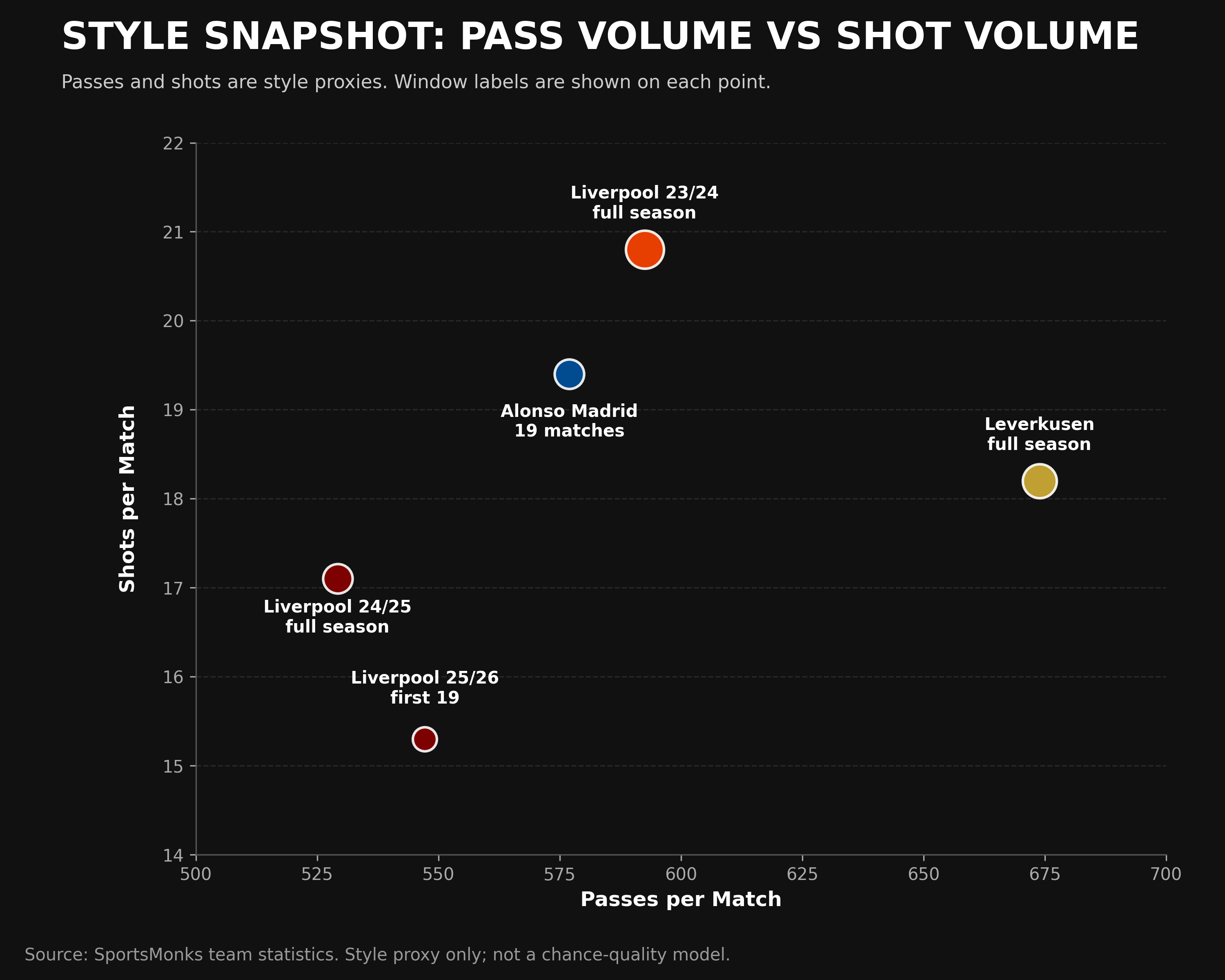
Leverkusen add one more useful contrast: they were the pass-volume control outlier at 673.9 passes per match, while Slot's Liverpool preserved more of the structural map but not Klopp's shot volume. Those passes and shots are style proxies, not proof of control, pressing or chance quality by themselves. The evidence points in the same direction. Alonso's data case is real; the fit question does not disappear.
The Best Pro-Alonso Case
The best pro-Alonso argument is simple: elite managers create fit rather than inherit it.
Leverkusen proved Alonso could build a dominant identity. Madrid showed he could move into different shapes and still produce. Liverpool would not have been hiring Leverkusen's formation sheet; they would have been hiring the problem-solver who built Leverkusen and then showed a different short-window shape mix in Madrid.
That is a fair argument. It may be the strongest Alonso argument available: not romance, but demonstrated quality plus evidence of flexibility. Its limit is sample strength. Madrid was a strong interrupted window, not a completed implementation.
That is why the fairest conclusion is not "Liverpool were right to avoid Alonso." That overclaims. It is this: Alonso was not a bad fit; he was a bigger tactical swing than the romance made him look.
The Real Choice Was Continuation Versus A Bigger Swing
Slot was not Klopp 2.0. That label is too crude. But his Liverpool remained recognisably Liverpool in structural terms: back-four base, wide-forward ecosystem, full-backs still central to the team, and a 4-2-3-1 that altered Klopp's midfield without forcing a total squad-role rewrite.
Alonso would not necessarily have brought Leverkusen's 3-4-2-1 to Anfield. Madrid's partial window suggests that. But Alonso would have brought a more open set of role questions. His Leverkusen side was a wing-back and central-creator masterpiece. His Madrid window was flexible, pass-secure, set-piece-productive and defensively strong, but also short, interrupted and formation-varied. Neither profile maps cleanly onto the simplistic idea of "Liverpool DNA" without serious work.
So the debate should not be framed as hearts versus spreadsheets. The romantic case for Alonso is real, and the data case for Alonso is also real. He is an outstanding coach. The more precise question is whether Liverpool needed to turn a post-Klopp transition into a deeper tactical reset.
On the available evidence, Alonso was not the obvious continuity appointment. He was the higher-profile, high-upside, potentially higher-disruption appointment. That is not an insult. Some elite coaches are worth the disruption.
Liverpool supporters do not have to choose between admiring Alonso and understanding the caution. The data supports both feelings: Alonso is elite, and the fit was never as simple as the story.